
Wells, Herbert George, Amazing Stories Volume 01 Number 01, 1926-04
A Flash Pulp Adaptation (5-minute read / ~750–850 words)
1. The Offer
Professor Gibberne arrived at my seaside lodging just after noon, coat flapping like he was outrunning the wind itself.
“I’ve done it,” he announced, eyes vibrating with a faint electric shine. “A compound that renders every living nerve a lightning bolt.”
He placed a small glass vial on my desk. The liquid inside trembled as if eager to escape.
“You want me to drink that?” I asked.
“I want you,” he said, “to witness time as it truly is—elastic, fragile, and unbearably slow.”
Despite myself, curiosity won. It always does.
We walked toward the beach, the air thick with salt and the distant clatter of children. Then, with a shared nod, we drank.
2. The First Shift
The world cracked.
Not loudly—more like a quiet hinge opening on a dimension we were never meant to see.
The wind stilled.
A dog mid-jump hovered like a statue carved from warm air.
A woman’s laughter froze in a perfect glass bubble halfway to the sky.
Only Gibberne moved, his grin stretching wildly.
“Glorious, isn’t it?” he shouted—though I heard him as a long, rolling echo.
My own body felt normal. My heartbeat steady. My breath smooth.
The difference was everything else—slowed to a syrupy crawl.
We were no faster, not really.
Time itself was slower for us.
3. The Consequences
We stepped across the beach in strides that felt like flying. Sand didn’t shift under our weight; it simply parted, too shocked to respond.
Even the sun seemed detained.
But exhilaration curdled quickly.
My clothes began to smolder. Not from fire—
from friction.
From speed.
“Move with intention,” Gibberne warned. “Even a casual gesture is a hurricane in this frame.”
He demonstrated, waving his hand slowly.
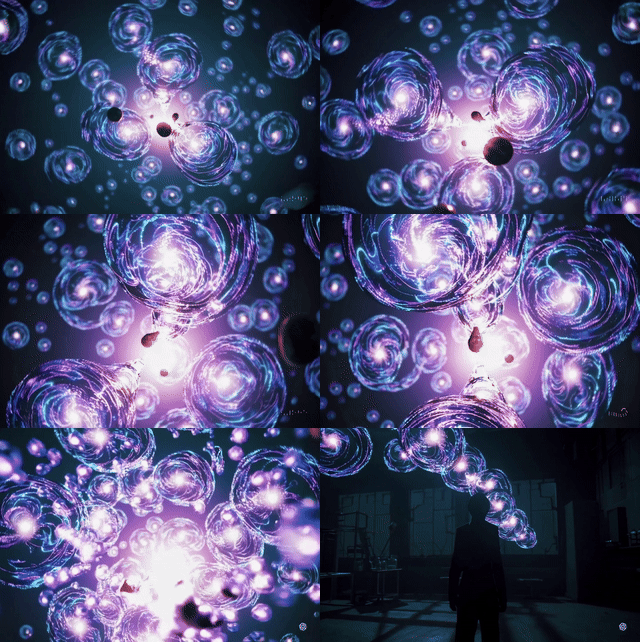
The motion still kicked up a violent spiral of dust, frozen in mid-air like a suspended galaxy.
Then the real danger appeared.
Oxygen.
My lungs, working at their new maximum tempo, demanded more than the sluggish world could deliver.
I gasped.
Nothing came.
Gibberne dragged me toward the sea. “Air near the water circulates faster. Stay calm.”
But calm was impossible when your body was outpacing the world’s ability to keep you alive.
4. The Incident
Near the pier, a carriage horse was mid-stumble—frozen on its way down. The driver hung above it, reins slack as a dream.
We stepped around them like ghosts.
Then a sharp pain cut my side.
Clothing torn open.
A pebble had hit me.
A small child had kicked a stone moments earlier; to us, it struck with the weight of a bullet.
I staggered.
The world felt thinner.
My heartbeat began to sync—dangerously—with the slowed rhythm of everything else.
Gibberne seized my arm.
“Listen. The effect will fade soon. But if we collapse here, we might never move again. The world will simply… overtake us.”
We pushed forward, each step a negotiation with physics and fate.
5. Return to Ordinary Time
The cracking sensation returned—this time in reverse.
Sound rushed in like a flood.
Waves roared.
Children screamed.
The dog landed, barking in confusion.
The woman’s laughter finished its arc and dissolved into air.
I collapsed on the warm sand, chest heaving, the ordinary world suddenly ferocious.
“Brilliant,” Gibberne wheezed beside me. “A triumph. Though… certain adjustments must be made before mass production.”
“Mass production?” I gasped. “You can’t be serious.”
“Oh, but imagine it!” he said, eyes glittering again.
“Wars fought in the blink of an eye. Emergencies resolved before they occur. History rewritten by the quick.”
“Or,” I countered, “humanity torn apart by running too fast for its own breath.”
He considered this.
For an entire second.
“Innovation always has its risks,” he finally said.
“But that’s tomorrow’s concern. For now… we’ve glimpsed the machinery behind the curtain.”
6. Coda
That night, as I lay awake, every sound of the normal world felt indecently slow.
A clock ticked like a hammer in tar.
The moon rose as though reluctant.
And I realized something terrifying:
Once you’ve moved outside time,
ordinary life feels like imprisonment.
I still have half the vial in my coat pocket.
I tell myself I’ll throw it into the sea.
But every evening, when the world drags its feet,
I feel the glass between my fingers—
light, warm, trembling—
as if the Accelerator remembers me
and wants me back.
-end


 Pulpverse — where pulps evolve.
Leave a comment